day
hr
min
sec

participants / team

The Department of Information and Technology Education, Ministry of Education, is primarily responsible for promoting policies and programs related to information education, technology education, digital learning, educational information systems, academic networks, information security, environmental education, and disaster prevention education. The Department is committed to integrating information technology with educational development, promoting digital learning, technology talent cultivation, and digital transformation in education, while continuing to strengthen educational environments, information infrastructure, and sustainable development.

感謝所有參賽隊伍與選手的熱情投入與精彩表現!本屆「2026 海廢影像辨識國際 AI 競賽(複賽)」複賽評選工作已圓滿結束。評審團依據實行可行性、完整度及說明文件 README.md 包含環境建置步驟、執行模型訓練與推論之指令說明等表現指標,經過嚴謹客觀的綜合評審,最終選出晉級決賽隊伍與模型輕量化獎名單。
We would like to extend our sincere gratitude to all participating teams and contestants for their enthusiastic involvement and outstanding performance! The final round evaluation for the 「2026 Marine Debris Image Recognition International AI Competition (Final Round)」 has successfully concluded.
Based on performance metrics including implementation feasibility, overall completeness, and documentation (specifically the README.md covering environment setup steps, as well as instructions for model training and inference execution), the review panel conducted a rigorous and objective comprehensive assessment to determine the winning teams and the Lightweight Model Award recipients.
獲獎團隊(Winning teams):
| Ranking | Team Name | Score |
| 1st Place | 金采源是我老婆 | 0.8159878 |
| 2nd Place | 我這一生如履薄冰 | 0.8080843 |
| 3rd Place | chmod 777 | chmod 777 |
模型輕量化獎(Best Lightweight Optimization Award):
| Number | Team Name | Score |
| 1 | 金采源是我老婆 | -20.16 |
| 2 | 我這一生如履薄冰 | -20.21 |
本屆參賽作品水準亮眼,多數隊伍展現出極高的專業度與問題解決能力。評審特別建議可加強以下兩點:
The entries in this year's competition demonstrated outstanding quality, with most teams exhibiting exceptional professionalism and problem-solving capabilities. The review panel offers the following two key recommendations for further enhancement:
再次感謝各位選手為海洋環境保護與 AI 應用創新所貢獻的能量與努力!頒獎典禮的時間會另做通知,敬請期待。
Once again, we extend our deepest gratitude to all contestants for their dedication and contributions to marine conservation and AI innovation. The schedule for the awards ceremony will be announced in due course. We look forward to celebrating your achievements.
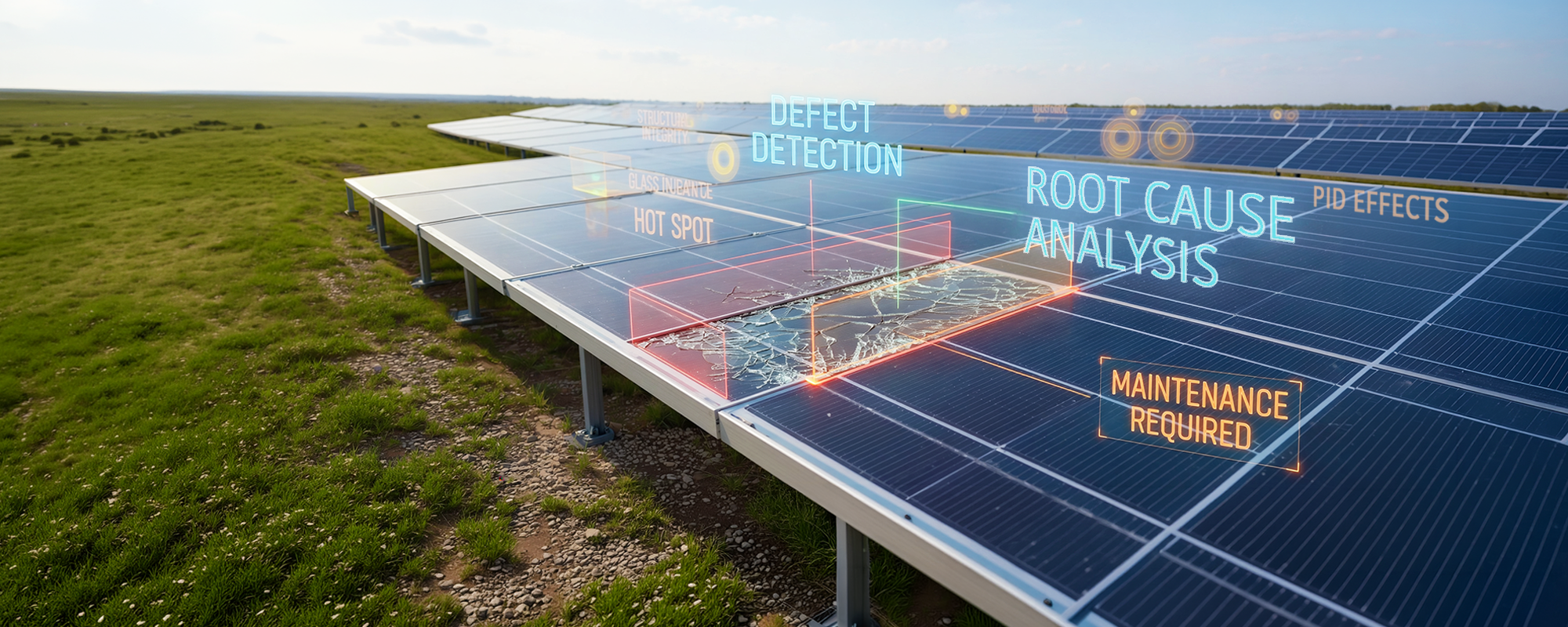
In response to global climate change and the energy transition, Taiwan has set net-zero emissions by 2050 as a national goal, and solar photovoltaics are also a key focus of renewable energy development. As installed capacity expands, solar panels are exposed over long periods to high temperatures, high humidity, windblown sand, and mechanical stress. Defects such as microcracks, hot spots, PID effects, encapsulation aging, and glass damage may reduce power generation efficiency, shorten equipment service life, and even pose safety risks.
This competition is based on visible-light (RGB) and thermal infrared (Thermal IR) images. Participants are required to detect defect locations and generate textual descriptions of the root causes of the defects. Participants may employ few-shot learning, synthetic data generation, weather adaptation, and multimodal vision-language models to develop intelligent solar panel inspection systems with low data requirements, generalization capability, and interpretability.
This competition is based on the solar panel visible-light and infrared image datasets provided by the organizer. Participating teams are required to develop an artificial intelligence system capable of performing defect localization and root cause text analysis. During the result-submission period, the system will display only Public evaluation scores and the Public Leaderboard for model development and performance adjustment. The final ranking will primarily be based on the Private Leaderboard evaluation result calculated from each team's last valid submission made before the result-submission deadline, together with a review of the source code and technical documentation.
Competition Procedure
Stage 1: Competition Registration and Dataset Release
Registration will open on September 16, 2026. The organizer will make the Training set available on September 16, 2026, and the Testing set available on September 30, 2026, for participating teams to download. Teams may use the Training set for data preprocessing, data augmentation, model training, and parameter adjustment, and use the completed model to generate prediction results for the Testing set.
Stage 2: Prediction Result Submission and Public Leaderboard
Participating teams must upload their Testing set prediction results to the online scoring and ranking system in the format specified by the organizer. During the result-submission period, the system will evaluate the Public score of each valid submission and display it on the Public Leaderboard. The Public Leaderboard will rank each team according to the Public evaluation score of its most recent valid submission, rather than its historical highest score, allowing teams to monitor model performance and make subsequent adjustments.
During the result-submission period, each team may submit Testing set prediction results up to three times per calendar day. Public and Private evaluations use the same submission count, and no additional Testing set submission opportunities are provided for the Private evaluation.
Stage 3: Final Evaluation and Private Leaderboard
After the result-submission deadline, each team's last valid submission made before the deadline will automatically be designated as its final submission. The organizer will use that submission to calculate the Private evaluation score and the Private Leaderboard. Teams do not need to submit separate Private prediction results. Private Leaderboard results will be announced on the date listed in the event schedule.
Stage 4: System Performance Evaluation
Participating systems must output defect locations and textual descriptions of defect root causes. The evaluation consists of the following two components:
The final score will be calculated by combining the above two metrics according to the scoring formula announced by the organizer.
Stage 5: Score Announcement and Document Review
The organizer is expected to announce the Private Leaderboard results on December 9, 2026. Designated teams must submit their prediction model documentation and complete source code between December 9 and December 16, 2026. If teams have created or additionally used training data or resources, these must also be submitted or fully described.
The submitted materials must include data preprocessing, model training, and inference programs, model weights, parameter settings, and the execution environment, enabling the organizer to verify the executability, reproducibility, and verifiability of the entries. Failure to complete execution or verification may affect the final ranking and award eligibility.
Stage 6: Final Ranking Determination
Based on the Private Leaderboard results and the review results of the programs, data, and technical documentation, the organizer will confirm that the entries comply with the competition rules and is expected to announce the final rankings on January 13, 2027.
Only teams composed entirely of students with active student status in the Republic of China at the time of registration are eligible for prize money and other material awards, including NCHC GPU computing resources. Teams in the General Division are not eligible for prize money or other material awards and may only receive certificates issued by the organizer. Eligible teams must provide proof of student status when the awards are presented. The total competition reward pool is tentatively set at NT$300,000, including NCHC GPU computing resources; actual award numbers, formats, and amounts are subject to the official announcement and the decision of the judging committee.
| Rank | Quota | Prize |
|---|---|---|
| First Place | 1 team | NT$100,000 |
| Second Place | 1 team | NT$50,000 |
| Third Place | 1 team | NT$30,000 |
| Outstanding Award | 2 team | NT$15,000 |
| Honorable Mention | 5 teams | NT$8,000 |
| Jury Special Award | 1 team | receiving NCHC GPU computing resources valued at NT$50,000. |
Registration for this competition will open on September 16, 2026, Taiwan Time (UTC+8). Dataset downloads and prediction result submissions will open according to the schedule for each stage. The final rankings will be announced on January 13, 2027, and the award ceremony is tentatively scheduled for March 2027. The schedule for each stage is as follows:
| 時間 | 事件 |
|---|---|
| 2026/09/16 | Registration and team formation open. |
| 2026/09/16 | Training set available. |
| 2026/09/16– 2026/11/16 23:59:59 | Registration period. |
| 2026/09/30 | Testing set available. |
| 2026/09/30– 2026/12/04 23:59:59 | Prediction result submissions. |
| 2026/12/09 | Private Leaderboard announced. |
| 2026/12/09 00:00:00– 2026/12/16 23:59:59 | Report and source code submission period. |
| 2027/01/13 | Final rankings announced. |
| Tentatively March 2027 | Award ceremony. |
All dates and times above are based on Taiwan Time (UTC+8). The actual schedule and event arrangements shall be subject to the organizer’s official announcements.
The final evaluation consists of two metrics:
For a consistent scoring scale, both $F1_{TIoU}$ and $F1_{TEXT}$ are represented on a 0-to-1 scale; the normalization of BERTScore-F1 shall follow the official evaluation kit announced by the organizer. Defect localization and root cause text quality are weighted at 70% and 30%, respectively, to calculate the final score. Leaderboard scores and final rankings shall be based on the results calculated by the official evaluation program provided by the organizer.
The combined task score for defect localization and root cause text is calculated as follows:
$$F1=0.7F1_{TIoU}+0.3F1_{TEXT}$$
where $F1_{TIoU}$ is the defect localization score and $F1_{TEXT}$ is the root cause text score.
The final score is calculated using this combined task score. The final Score ranges from 0 to 1, with a higher score indicating better overall performance. If there are no valid predictions or other boundary cases occur during calculation, the implementation of the official evaluation program announced by the organizer shall prevail.