
For registration, please see the introduction
00

day

00

hr

00

min

00

sec

Time to start

0 / 0

participants / team


Topic provider

The Department of Information and Technology Education, Ministry of Education, is primarily responsible for promoting policies and programs related to information education, technology education, digital learning, educational information systems, academic networks, information security, environmental education, and disaster prevention education. The Department is committed to integrating information technology with educational development, promoting digital learning, technology talent cultivation, and digital transformation in education, while continuing to strengthen educational environments, information infrastructure, and sustainable development.

The National Yang Ming Chiao Tung University College of Artificial Intelligence was established in 2019 at the university’s Tainan Campus in support of the government’s development of the Shalun Smart Green Energy Science City and the industry–academia–research cluster in southern Taiwan. It is Taiwan’s first college dedicated to artificial intelligence. The College comprises the Institute of Smart Computing and Technology, the Institute of Intelligent Systems and Applications, and the Institute of Smart and Green Energy Industry. Its primary teaching and research areas include artificial intelligence, intelligent computing, the Internet of Things, machine learning, big data analytics, and green energy. The College is committed to cultivating advanced technology professionals with expertise in electrical engineering, information technology, science and engineering, and industrial practice.
The National Yang Ming Chiao Tung University College of Artificial Intelligence aims to become a world-leading center for artificial intelligence research and education, emphasizing interdisciplinary integration across science and engineering, theory and application, and software and hardware. By combining the university’s research capabilities, industry faculty, and industrial resources, the College promotes innovative research and practical applications in artificial intelligence and green energy technologies, thereby enhancing talent cultivation and the effectiveness of industry–academia collaboration. At the same time, the College incorporates the concept of sustainable development into its research and education, aligning with the United Nations Sustainable Development Goals related to industry, innovation and infrastructure, as well as sustainable cities and communities. It continues to contribute research capacity and talent to smart technologies, green energy, and Taiwan’s industrial transformation.

Introduction

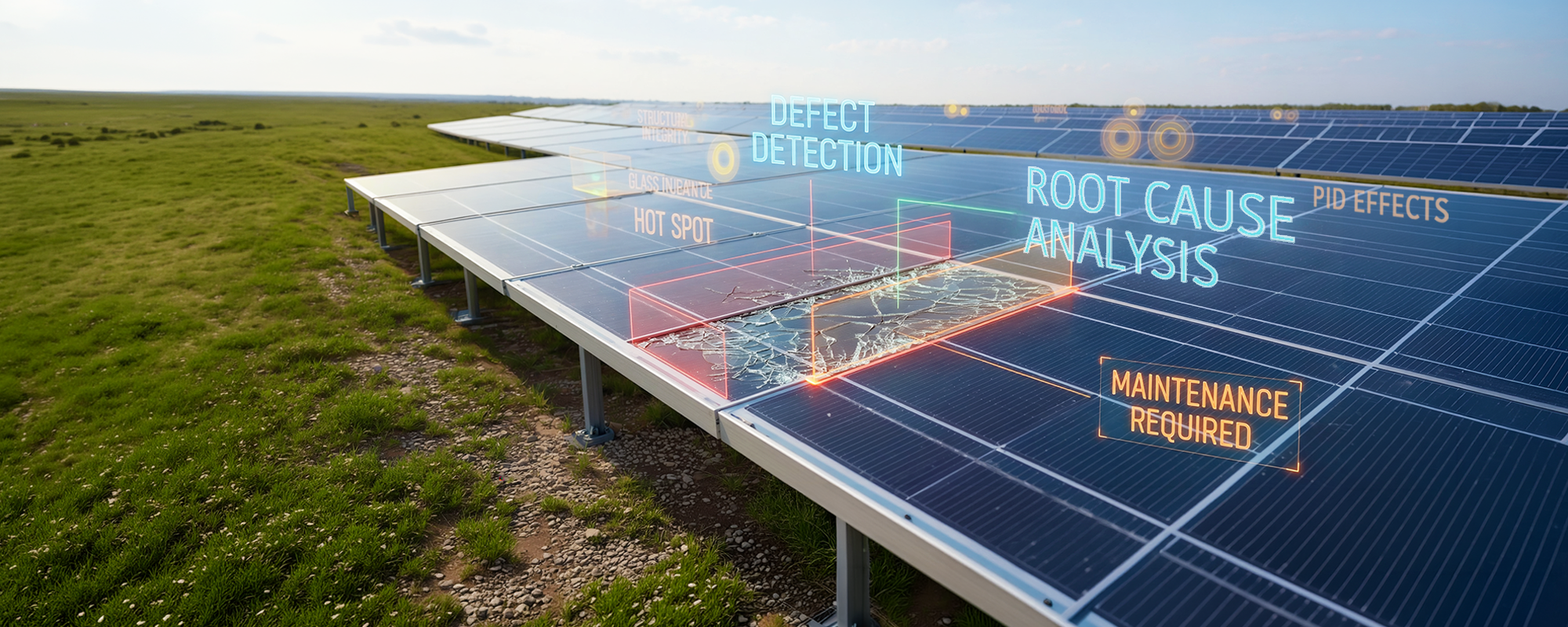
In response to global climate change and the energy transition, Taiwan has set net-zero emissions by 2050 as a national goal, and solar photovoltaics are also a key focus of renewable energy development. As installed capacity expands, solar panels are exposed over long periods to high temperatures, high humidity, windblown sand, and mechanical stress. Defects such as microcracks, hot spots, PID effects, encapsulation aging, and glass damage may reduce power generation efficiency, shorten equipment service life, and even pose safety risks.

This competition is based on visible-light (RGB) and thermal infrared (Thermal IR) images. Participants are required to detect defect locations and generate textual descriptions of the root causes of the defects. Participants may employ few-shot learning, synthetic data generation, weather adaptation, and multimodal vision-language models to develop intelligent solar panel inspection systems with low data requirements, generalization capability, and interpretability.

  • For inquiries, please contact: aicup2026.solardefect@gmail.com
  • ※Registration for this competition topic is expected to be conducted through the AI CUP registration system. The registration link and platform operation instructions shall be subject to the official announcement.

Eligibility

  • Students who hold active student status in the Republic of China at the time of registration, including senior high school, vocational high school, college, university, and graduate students, may form teams to participate.
  • Members of the general public may also participate and will be included in the overall ranking. Teams in the General Division are eligible only for certificates issued by the organizer and are not eligible for prize money or other material awards.
  • A team composed entirely of students will be classified in the Student Division. A team with any non-student member will be classified in the General Division.
  • Eligibility for prize money and other material awards, including GPU computing resources, is limited to teams whose members all hold active student status in the Republic of China at the time of registration. Supporting documentation must be provided when claiming the award.

Competition Guidelines and Judging Criteria

This competition is based on the solar panel visible-light and infrared image datasets provided by the organizer. Participating teams are required to develop an artificial intelligence system capable of performing defect localization and root cause text analysis. During the result-submission period, the system will display only Public evaluation scores and the Public Leaderboard for model development and performance adjustment. The final ranking will primarily be based on the Private Leaderboard evaluation result calculated from each team's last valid submission made before the result-submission deadline, together with a review of the source code and technical documentation.

Competition Procedure

Stage 1: Competition Registration and Dataset Release
Registration will open on September 16, 2026. The organizer will make the Training set available on September 16, 2026, and the Testing set available on September 30, 2026, for participating teams to download. Teams may use the Training set for data preprocessing, data augmentation, model training, and parameter adjustment, and use the completed model to generate prediction results for the Testing set.

Stage 2: Prediction Result Submission and Public Leaderboard
Participating teams must upload their Testing set prediction results to the online scoring and ranking system in the format specified by the organizer. During the result-submission period, the system will evaluate the Public score of each valid submission and display it on the Public Leaderboard. The Public Leaderboard will rank each team according to the Public evaluation score of its most recent valid submission, rather than its historical highest score, allowing teams to monitor model performance and make subsequent adjustments.
During the result-submission period, each team may submit Testing set prediction results up to three times per calendar day. Public and Private evaluations use the same submission count, and no additional Testing set submission opportunities are provided for the Private evaluation.

Stage 3: Final Evaluation and Private Leaderboard
After the result-submission deadline, each team's last valid submission made before the deadline will automatically be designated as its final submission. The organizer will use that submission to calculate the Private evaluation score and the Private Leaderboard. Teams do not need to submit separate Private prediction results. Private Leaderboard results will be announced on the date listed in the event schedule.

Stage 4: System Performance Evaluation
Participating systems must output defect locations and textual descriptions of defect root causes. The evaluation consists of the following two components:

  1. Defect Region Localization Accuracy: The overlap between the polygon regions predicted by the model and the manually annotated Ground Truth Polygons will be compared, and the localization score will be calculated based on Precision and Recall.
  2. BERTScore for Root Cause Analysis: The semantic similarity between the defect descriptions generated by the system and the reference answers will be compared to evaluate the quality of root cause analysis and textual explanations.

The final score will be calculated by combining the above two metrics according to the scoring formula announced by the organizer.

Stage 5: Score Announcement and Document Review
The organizer is expected to announce the Private Leaderboard results on December 9, 2026. Designated teams must submit their prediction model documentation and complete source code between December 9 and December 16, 2026. If teams have created or additionally used training data or resources, these must also be submitted or fully described.
The submitted materials must include data preprocessing, model training, and inference programs, model weights, parameter settings, and the execution environment, enabling the organizer to verify the executability, reproducibility, and verifiability of the entries. Failure to complete execution or verification may affect the final ranking and award eligibility.

Stage 6: Final Ranking Determination
Based on the Private Leaderboard results and the review results of the programs, data, and technical documentation, the organizer will confirm that the entries comply with the competition rules and is expected to announce the final rankings on January 13, 2027.

Prize

Only teams composed entirely of students with active student status in the Republic of China at the time of registration are eligible for prize money and other material awards, including NCHC GPU computing resources. Teams in the General Division are not eligible for prize money or other material awards and may only receive certificates issued by the organizer. Eligible teams must provide proof of student status when the awards are presented. The total competition reward pool is tentatively set at NT$300,000, including NCHC GPU computing resources; actual award numbers, formats, and amounts are subject to the official announcement and the decision of the judging committee.

RankQuotaPrize
First Place1 teamNT$100,000
Second Place1 teamNT$50,000
Third Place1 teamNT$30,000
Outstanding Award2 teamNT$15,000
Honorable Mention5 teamsNT$8,000
Jury Special Award1 team

receiving NCHC GPU computing resources valued at NT$50,000.

  • Teams ranked among the top 15 in the final ranking and composed entirely of students will receive a Ministry of Education certificate upon approval by the judging committee.
  • Teams ranked within the top 25% and achieving a score higher than the Baseline, including teams in the General Division, may receive a certificate issued by the organizer.
  • The number of awards may be adjusted according to the number and performance of participating entries. If the submitted entries do not meet the required standard, the final-round judging committee may decide not to present certain awards or to select fewer recipients.
  • Eligibility for prize money and other material awards, including NCHC GPU computing resources, is limited to teams whose members all hold active student status in the Republic of China at the time of registration, and supporting documentation must be provided when the awards are presented.
  • The Baseline Score is 0.6523, and the final Score ranges from 0 to 1.

Activity time

Registration for this competition will open on September 16, 2026, Taiwan Time (UTC+8). Dataset downloads and prediction result submissions will open according to the schedule for each stage. The final rankings will be announced on January 13, 2027, and the award ceremony is tentatively scheduled for March 2027. The schedule for each stage is as follows:

時間事件
2026/09/16Registration and team formation open.
2026/09/16Training set available.
2026/09/16–
2026/11/16 23:59:59
Registration period.
2026/09/30Testing set available.
2026/09/30–
2026/12/04 23:59:59
Prediction result submissions.
2026/12/09Private Leaderboard announced.
2026/12/09 00:00:00–
2026/12/16 23:59:59
Report and source code submission period.
2027/01/13Final rankings announced.
Tentatively March 2027Award ceremony.

All dates and times above are based on Taiwan Time (UTC+8). The actual schedule and event arrangements shall be subject to the organizer’s official announcements.

Evaluation Criteria Guidelines

The final evaluation consists of two metrics:

  • Defect Localization: $F1_{TIoU}$ is calculated based on $TIoU$ to evaluate the degree of overlap between the predicted polygons and the Ground Truth polygons, while also considering missed detections, duplicate detections, and excessive detections. The localization evaluation covers Normal and all defect classes. The scoring and aggregation methods for each class shall be subject to the official evaluation program announced by the organizer.
  • Root Cause Text: $F1_{TEXT}$ is calculated using the F1 value of BERTScore to evaluate the semantic similarity between the root cause descriptions generated by the participating system and the reference answers. Root cause text is evaluated only for defect regions that have completed instance matching. The matching method between predicted regions and Ground Truth, the aggregation method for multiple reference root cause descriptions, and the handling of missed detections, duplicate predictions, unmatched results, and blank text shall be subject to the official evaluation kit announced by the organizer. The language used for root cause text and the BERTScore model settings will be announced together with the evaluation kit.

For a consistent scoring scale, both $F1_{TIoU}$ and $F1_{TEXT}$ are represented on a 0-to-1 scale; the normalization of BERTScore-F1 shall follow the official evaluation kit announced by the organizer. Defect localization and root cause text quality are weighted at 70% and 30%, respectively, to calculate the final score. Leaderboard scores and final rankings shall be based on the results calculated by the official evaluation program provided by the organizer.

Evaluation Criteria

The combined task score for defect localization and root cause text is calculated as follows:

$$F1=0.7F1_{TIoU}+0.3F1_{TEXT}$$

where $F1_{TIoU}$ is the defect localization score and $F1_{TEXT}$ is the root cause text score.

The final score is calculated using this combined task score. The final Score ranges from 0 to 1, with a higher score indicating better overall performance. If there are no valid predictions or other boundary cases occur during calculation, the implementation of the official evaluation program announced by the organizer shall prevail.


Rules

  1. Submission of Prediction Results and Ranking Method
    1. During the result-submission period, each team may upload Testing set prediction results up to three times per calendar day. During this period, the system will display only Public evaluation scores and the Public Leaderboard. The Public Leaderboard will rank each team according to the Public evaluation score of its most recent valid submission and will not retain or use the historical highest score. These results are provided for model adjustment and performance comparison.
    2. Public and Private evaluations use the same Testing set submission records and the same submission count; no additional Private submission opportunity is provided. At the result-submission deadline, each team's last valid submission made before the deadline will automatically become its final submission and will be used to calculate the Private evaluation score and the Private Leaderboard, which serve as the basis for the final ranking. Public Leaderboard scores are for reference only during the competition and will not be included in the final ranking.
  2. Competition Account Usage Rules
    1. Participating teams may not register or use multiple accounts to participate in the same competition. If a team member uploads prediction results using a separate personal account, this will also be regarded as participation using multiple accounts. Violators may be disqualified by the organizer.
  3. Team Participation Rules
    1. This competition adopts team-based registration, with each team consisting of 1 to 5 members.
    2. Each team must designate 1 team leader to serve as the contact and recipient representative for competition notifications, document submission, awards, prize distribution, and other related matters.
    3. Each participant may join only one team.
    4. After joining a team, a participant may not transfer to another team.
    5. After the registration deadline, team members may not be added, removed, or replaced.
    6. During the competition, teams may not merge or split.
  4. Use of Additional Data and Resources
    1. Participating teams may use additional images, public datasets, pretrained models, software packages, or self-created data for data augmentation and model training.
    2. If resources other than the datasets provided by the organizer are used, their names, sources, licensing terms, and actual uses must be fully described in the final written report. In the event of any dispute regarding their use, the organizer reserves the right to make the final decision.
  5. Handling of Test Data and Prediction Results
    1. Participating teams may not manually annotate, modify, correct, or adjust the test data or their prediction results. All results submitted to the Leaderboard system must be automatically generated by the machine learning or deep learning system developed by the participating team.
  6. Rules for the Exchange of Programs and Technical Information
    1. During the competition, teams may not privately share source code, model weights, features derived from the test set, or other information that may directly affect the competition results. General technical issues may be discussed publicly in the official discussion forum designated by the organizer.
  7. Final Deliverables and Source Code Review
    1. To ensure competition fairness and the verifiability of the evaluation results, the organizer will require designated teams to submit a final report and complete implementation results within the specified period, including but not limited to:
      1. Information on participating team members.
      2. Descriptions of the model architecture and algorithms.
      3. Source code and operating instructions for data preprocessing, model training, and inference.
      4. Model weights, parameter settings, and the execution environment.
      5. Descriptions of additionally used data, models, packages, and other resources.
      6. Training data created by the participating team.
      7. The submitted source code must be successfully executable in the environment specified by the organizer or in Google Colaboratory in order to reproduce and verify the competition results. If the program cannot be executed, the results cannot be reproduced, or the documentation is incomplete, the final ranking and award eligibility may be affected.
  8. Originality and Academic Ethics Rules
    1. This competition encourages participating teams to propose original technical concepts, model designs, and application methods. If an entry uses methods, algorithms, models, source code, datasets, or other resources proposed by others, the technical report must clearly indicate the citations, sources, and methods of use, and must comply with the applicable licensing terms and laws.
    2. Participating teams must respect intellectual property rights and academic ethics and may not engage in plagiarism, misappropriation, fabrication, falsification, or concealment of data or technical sources. If a violation of intellectual property rights, academic ethics, or applicable laws is verified, the organizer may disqualify the team from participation or receiving awards. Any related legal liability shall be borne by the participating team.
  9. Prize Taxation Rules
    1. Prize money received by winning teams must be declared as income and subject to tax withholding in accordance with the relevant tax laws of the Republic of China. Any related tax liabilities shall be borne by the award recipients in accordance with the law.
  10. Dataset Adjustments
    1. The organizer may adjust the dataset during the competition based on competition implementation, data quality, system operation, or evaluation requirements. The details and effective dates of any related changes shall be subject to the organizer’s official announcements.
  11. Circumstances for Disqualification from Participation or Awards
    1. If any of the following circumstances occurs, the organizer may directly disqualify a participant or team from participation or receiving awards without prior notice:
      1. There is concrete evidence proving that the team has engaged in plagiarism, cheating, fabrication, fraud, or similar conduct.
      2. There is concrete evidence proving that the team has infringed upon the intellectual property rights of others or violated academic ethics.
      3. There is concrete evidence proving that the team has attacked, interfered with, or improperly operated the Leaderboard system.
      4. There is concrete evidence proving that the team has influenced other participating teams and created unfair competition.
      5. The team has used multiple accounts to participate in the competition or upload prediction results.
      6. The team has violated these competition rules, organizer announcements, or engaged in other conduct affecting competition fairness.
  12. Handling of Awards Obtained in Violation of the Rules
    1. If a participating team violates these competition rules, the organizer may disqualify the team from participation. If the team has already received an award, the organizer may revoke its award eligibility and awards, and recover any prize money, certificates, and other related rewards that have already been issued.
  13. Eligibility for Prize Money and Certificates
    1. Eligibility for prize money and other material awards, including NCHC GPU computing resources, is limited to teams whose members all hold active student status in the Republic of China at the time of registration, and relevant proof of identity must be provided when the awards are presented.
    2. Teams in the General Division may participate in the overall ranking but are not eligible for prize money or other material awards. If they meet the relevant award requirements, they are eligible only for certificates issued by the organizer.
  14. Rules for Faculty Advisors or Industry Mentors
    1. Faculty advisors or industry mentors may not register as participants together with students. If a team has a faculty advisor or industry mentor, the team must provide the advisor’s or mentor’s name, school or company name, department or job title, and email address in the relevant fields of the registration system and in the final report.
    2. Based on the email information provided by the team, the organizer will contact the faculty advisor or industry mentor to complete a supervision verification form. Faculty advisors or industry mentors are optional, and teams without an advisor or mentor are not required to provide this information.
  15. Certificates and Number of Awards
    1. Teams ranked among the top 15 in the final ranking and composed entirely of students may receive a Ministry of Education certificate upon approval by the judging committee.
    2. Teams ranked within the top 25% and achieving a score above the Baseline, including teams in the General Division, may receive a certificate issued by the organizer upon approval by the judging committee. Teams in the General Division are not eligible for prize money or other material awards.
    3. The number of awards may be adjusted according to the number and performance of participating entries. If the submitted entries do not meet the evaluation standard, the judging committee may decide not to present certain awards or to select fewer recipients.
  16. Matters Not Covered
    1. For matters not covered by these competition rules, the organizer may determine appropriate handling methods according to the actual circumstances of the competition, and the organizer’s official announcements shall prevail.
  17. Agreement to the Rules
    1. By completing registration, participants are deemed to have read, understood, and fully agreed to comply with these competition rules, related regulations, and subsequent announcements issued by the organizer.
  18. Dispute Resolution and Final Right of Interpretation
    1. In the event of any dispute concerning the competition rules, participant eligibility, evaluation results, award distribution, or other related matters, the organizer reserves the final right to interpret and make decisions regarding this competition, its rules, and the evaluation results.